

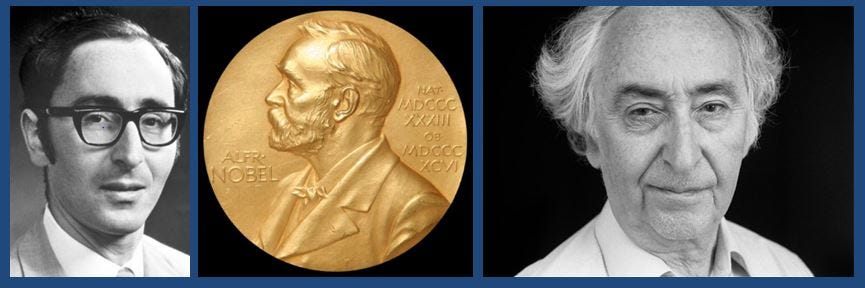
In the Pulitzer Prize-winning book “The Social Transformation of American Medicine,” Paul Starr describes the impressive popularity of homeopathic medicine in the late 19th century, “Because homeopathy was simultaneously philosophical and experimental, it seemed to many people to be more rather than less scientific than orthodox medicine.”
Brian Josephson, PhD (1940– ) is a British physicist who won a Nobel Prize in Physics in 1973 for work he completed when he was only 22 years old. He is currently a professor emeritus of physics at the University of Cambridge where he was the head of the mind-matter unification project in the Theory of Condensed Matter research group.
Responding to an article in the New Scientist (October 18, 1997), Josephson wrote:
Regarding your comments on claims made for homeopathy: criticisms centered around the vanishingly small number of solute molecules present in a solution after it has been repeatedly diluted are beside the point, since advocates of homeopathic remedies attribute their effects not to molecules present in the water, but to modifications of the water’s structure.
Simple-minded analysis may suggest that water, being a fluid, cannot have a structure of the kind that such a picture would demand. But cases such as that of liquid crystals, which while flowing like an ordinary fluid can maintain an ordered structure over macroscopic distances, show the limitations of such ways of thinking. There have not, to the best of my knowledge, been any refutations of homeopathy that remain valid after this particular point is taken into account.
A related topic is the phenomenon, claimed by esteemed French physician and researcher Jacques Benveniste known as “memory of water”. If valid, this would be of greater significance than homeopathy itself, and it attests to the limited vision of the modern scientific community that, far from hastening to test such claims, the only response has been to dismiss them out of hand (Josephson, 1997).
Josephson’s remarks on the structure of water have been confirmed by more recent research (Roy, et al., 2005) from the highly honored scientist, Rustom Roy, PhD, who co-founded the Materials Research Society and became an Evan Pugh Professor at Pennsylvania State University, one of the university’s highest honors. One of Roy’s co-authors of this study was William Tiller, PhD, the former head of the department of material sciences at Stanford University.
These leading scientists described how the process of making homeopathic medicines changes the water to turn it into a medicine and differentiate it from simple or plain water. The shaking process, an integral part of making homeopathic medicines, is now known to create bubbles and nano-bubbles that change the pressure and structure of the water.
Josephson was interviewed by the New Scientist (December 9, 2006), and asked to comment on how he became an advocate of unconventional ideas. He responded:
I went to a conference where the French immunologist Jacques Benveniste was talking for the first time about his discovery that water has a ‘memory’ of compounds that were once dissolved in it – which might explain how homeopathy works. His findings provoked irrationally strong reactions from scientists, and I was struck by how badly he was treated.
Josephson went on to describe how many scientists today suffer from “pathological disbelief”; that is, they maintain an unscientific attitude that is embodied by the statement “even if it were true I wouldn’t believe it.”
For Josephson, this was the opposite of the scientific ideal. In his view, science should remain open to anomalies and unexplained phenomena, especially when there are reproducible observations that do not yet fit accepted theory. He compared such resistance to earlier historical cases where scientific establishments initially rejected ideas later accepted as real, such as meteorites and continental drift.
Importantly, Josephson was not saying that all claims made for homeopathy are automatically true. Rather, he argued that:
· controversial findings deserve fair investigation,
· ridicule is not a scientific argument,
· and the absence of a currently accepted mechanism should not automatically invalidate empirical observations.
This position later resonated with other Nobel laureates who expressed openness to aspects of high-dilution research, including Luc Montagnier, who stated in a 2010 interview in Science that “high dilutions of something are not nothing.”
Ultimately, Josephson’s phrase “pathological disbelief” was essentially a criticism of what he viewed as dogmatic scientific skepticism—an attitude where certain ideas are dismissed a priori rather than investigated impartially.
(FOR REFERENCES TO THE ABOVE INFORMATION, SEE THE BOTTOM ON THIS ARTICLE!)
STRONG Clinical Evidence from Meta-analyses and Systematic Reviews
One of the strongest statements verifying the efficacy of homeopathic medicines was the confirmation that four of the five leading previous systematic reviews of homeopathic research found a benefit from homeopathic treatment over that of placebo:
“Five systematic reviews have examined the RCT research literature on homeopathy as a whole, including the broad spectrum of medical conditions that have been researched and by all forms of homeopathy: four of these ‘global’ systematic reviews reached the conclusion that, with important caveats, the homeopathic intervention probably differs from placebo.”
Mathie RT, Lloyd SM, Legg LA, Clausen J, Moss S, Davidson JR, Ford I. Randomised placebo-controlled trials of individualised homeopathic treatment: systematic review and meta-analysis. Systematic Reviews 2014; 3:142. doi:10.1186/2046-4053-3-142
http://www.systematicreviewsjournal.com/content/3/1/142
Homeopathic Clinical Research has been Published in Many of the BEST and MOST RESPECTED Medical Journals in the World
Some people and some media still claim that “there is no research that shows that homeopathic medicines are effective. HOWEVER, many of the best and most respected medical journals in the world have published studies on homeopathy that have shown its efficacy:
Homeopathic clinical studies have been published in The Lancet, BMJ (British Medical Journal), Pediatrics, European Journal of Pediatrics, Pediatrics Infectious Disease Journal, Chest (the journal of the American College of Chest Physicians), Cancer (the journal of the American Cancer Society), Rheumatology (journal of the British Society of Rheumatology), PlosOne, Journal of Clinical Epidemiology, European Journal of Obstetrics and Gynecology and Reproductive Biology (the journal of multiple societies of obstetrics and gynecology), and Cureus (published by Nature/Springer).
The above paragraph is worthy of copying and sharing with others. Please link back to this article and this Substack blog for attribution.
REFERENCES:
George, A. Lone voices special: Take nobody’s word for it. New Scientist, December 6, 2006. https://www.newscientist.com/article/mg19225812-200-lone-voices-special-take-nobodys-word-for-it/
Josephson, B. D., Letter, New Scientist, November 1, 1997.
Roy, R., Tiller, W. A., Bell, I., and Hoover, M. R. The Structure of Liquid Water: Novel Insights from Materials Research; Potential Relevance to Homeopathy, Materials Research Innovations, December 2005, 9(4):577–608. https://www.researchgate.net/publication/252170362_The_Structure_Of_Liquid_Water_Novel_Insights_From_Materials_Research_Potential_Relevance_To_Homeopathy
Biography:
DANA ULLMAN, MPH, CCH, received his Bachelor’s degree (1975) and his masters in public health from UC Berkeley (1978). UC Berkeley’s alumni magazine published a feature interview with Dana Ullman here.
Besides writing a lot about homeopathy and real healing, Dana has an active clinical homeopathic practice via Zoom, which means that he sees patients from all over the world. You can see his fee structure here, and to inquire about having a homeopathic consultation, email him at: email@homeopathic.com — you will receive a summary of his policies and fees, and upon agreeing to these simple policies, you will be given a day/time for the first hour-long consultation.
He is one of America’s leading advocates for homeopathy. He has authored 10 books, including The Homeopathic Revolution: Why Famous People and Cultural Heroes Choose Homeopathy, Homeopathy A-Z, Homeopathic Medicines for Children and Infants, Discovering Homeopathy, and (the best-selling) Everybody’s Guide to Homeopathic Medicines (with Stephen Cummings, MD). Dana also created an e-course How to Use a Homeopathic Medicine Kit which integrates 80 short videos with his famous ebook that is a continually growing resource to 500+ clinical studies published in peer-review medical journals testing homeopathic medicines. This ebook is entitled Evidence Based Homeopathic Family Medicine.
Dana Ullman has also authored chapters on homeopathic medicine that included in medical textbooks published by Oxford University Press, the American Academy of Pain Management, and Mosby.
He is the founder of Homeopathic Educational Services, also known as www.homeopathic.com, America’s leading resource center for homeopathic books, tapes, medicines, software, and e-courses. Homeopathic Educational Services has co-published over 40 books on homeopathy with North Atlantic Books.
Dana previously wrote a regular column for the popular website, www.huffingtonpost.com (to access these articles, click HERE!)
Dana’s most recent academic publication was “Rockefeller, the Flexner Report, and the American Medical Association: The Contentious Relationship Between Conventional Medicine and Homeopathy in America.”
30 years ago I witnessed Homeopathy work on my children when they were babies and toddlers, on several occasions. Mothers know! My pediatrician would ask me, What did you do? What did you give your child? When one of my daughters with ear infections or coughs would have resolution with homeopathy. I would go to him for a diagnostic and then go back a week later when my daughter was healed. He was trained as a doctor of osteopathy, but was handing out antibiotics left and right.
Most recently, homeopathy pulled me out of a long and deep fatigue and healed our dog of pancreatitis.
I start my Homeopathy studies at CHE online in September.
We know it is a threat to big Pharma and big medicine, because it heals quickly, without doing harm and is affordable, plus moms can treat their families at home.
2 very strong facts to testify for homeopathy.
First - Rockefeller had a homeopathic doctor
Second - homeopathy and herbal meds work on animals. Humans can fake, but dogs cats and horses do not.